Best Investment Plan in India for Senior Citizens


Once you retire, you would have earned a good amount of retirement money, however your regular monthly income stops. You feel, your luxury has gone away. You would try to reduce your expenses. This is what most of the Senior Citizens in India think. However, as a Senior Citizen, if you can plan it well, you can earn high returns on your retirement money. Which are the best investment plans for Senior Citizens in India? Which are the best investment options that can give higher returns for retired individuals? This article would provide some insights about good investment plans for Senior Citizens .

Here are some of the best investment options available for Senior Citizens. However, one should choose them based on tenure and any risk appetite (which is generally low anyways).
1) Senior Citizens Saving Scheme (SCSS)
It is a special account that can be opened by the senior citizens of India. It is a risk-free and tax-saving investment scheme that offers regular income to senior citizens. This scheme is available from major banks and post offices across India. Hindu Undivided Families (HUF) and NRIs are not allowed to invest in this scheme.
Who is eligible?
Any citizen who has attained 60 years of age.
The retirees who have opted for the VRS (Voluntary Retirement Scheme) or Superannuation between the ages of 55-60 years of age can also invest within a month of receiving the retirement corpus.
Retired defense personnel with a minimum age of 50 years.
What is the investment amount?
A maximum of Rs 15 lakhs (in the multiples of Rs. 1,000) can be invested in it either individually or jointly. The amount invested in the scheme cannot exceed the amount that has been received on the retirement.
The account can be opened by cash for an amount below Rs 1 lakh and by cheque for an amount above Rs 1 lakh. It offers a very good interest rate of 8.3% (Current), which is better than any FD or savings account. The tenure of this scheme is 5 years, which can be extended for 3 more years. If one invests Rs 15 Lakh at a 8.3 % interest rate in this scheme, senior citizen would get Rs 10,500 (approximately) per month. It is one of the safest investment option for Senior Citizen in India.
2) Post Office Monthly Income Plan (POMIP)
As the name suggests, this investment can be made in any post offices in India. It is a scheme to earn monthly income with lower risks. The investments are not exposed to market risks and hence it is a safe investment option. 
Who is eligible to invest?
Any Indian citizen can invest in this scheme.
NRIs cannot invest in this scheme.
What is the investment amount, Interest and tenure?
A maximum of Rs 4.5 lakh can be invested individually or Rs  9 lakh jointly. The account can be opened in the name of children also, provided that the age of the child is 10 years or above. The lock-in period is 5 years and the interest rate is 7.3% per annum. If the investor wishes to go for early withdrawals, they have to pay pre closure penalty. If the amount is withdrawn before one year, there is zero benefit. If it is withdrawn between 1st to 3rd year, the whole of the deposit is refunded after 2% penalty on the interest amount. If withdrawn between 3rd to 5th year, the entire amount is refunded after charging 1% penalty. The post office investment does not fall u/s 80C of the Income Tax Act and the interest amount received is taxable. If one invests Rs 9 Lakh at a 7.3 % interest rate in this scheme, senior citizen would get Rs 3,250 (approximately) per month. This is one of the best investment plan in India for Senior Citizen which is safe.
3) Monthly income Plan (MIP) Mutual Funds
MIP mutual funds are suitable for retirees and or for those individuals who are looking for regular returns with moderate risk. It is basically a debt-oriented hybrid mutual fund scheme which invests around 70% – 80% of the total corpus in debt instruments like government bonds, debentures etc. and the rest is invested in equity. The main objective of such MIP mutual fund investments is to provide steady income at regular intervals (may be monthly, quarterly or half-yearly) in the form of periodic dividend payouts. MIPs offers two options – dividend and growth. Under the dividend option, the fund houses offer regular dividends but it is not mandatory to declare dividends if the fund houses don’t have profits to distribute. However, one must note that the name is misleading and one does not get monthly income regularly as the name suggests. In the growth option, you will not get regular dividends. Rather the profit is added, to the NAV of the scheme. It is suitable for investors who want to see their funds growing.
Who can invest in this scheme?
Any individual, including NRIs can invest in this scheme.
4) Bank Fixed Deposits – Interest rates between 6.5% to 8% per annum
All banks offer higher interest rates to the senior citizens of India. This makes this investment lucrative as this is the safest and most guaranteed mode of investment. There are a several senior citizen fixed-deposit schemes to choose from with many varied features attached like interest payouts, loan facility, over-draft facility, flexible tenure, etc. Banks offer different rates of interest ranging between 6.5% to 8%. The interest rates are offered best in the tenure of 1-5 years. The highest rate of interest on senior citizen FDs is being offered by IDFC bank, which is 8% for 366 days. Some banks may allow customers to open this account at the age of 55 years who have taken VRS. The interest earned on FD would be liable for income tax based on the income tax rate applicable to them. The senior citizens may opt for different interest payout options (Monthly, Quarterly or Yearly) to get a regular income.
5) Pradhan Mantri Vaya Vandhana Yojana (PMVVY)
In July 2017, the Government of India announced this pension scheme exclusively for citizens who are 60 years and above.  Life Insurance Corporation of India (LIC) has been given the sole rights to run this scheme. It can be purchased online or offline. This scheme was supposed to be open for one year, but now it has been extended till March 2020. Pradhan Mantri Vaya Vandhana Yojana Scheme provides an assured 8% per annum return payable monthly for 10 years. The proposed changes in Budget 2018 will double it to Rs 15 Lakh.  A pension will be payable at the end of each period (monthly, quarterly, half-yearly or yearly) as chosen by the pensioner. It is exempted from Goods and service Tax (GST).   
Currently, in the monthly mode, an investor in the PMVVY scheme gets a monthly interest rate of Rs. 5,000 if he invests Rs. 7,50,000.
It also allows for a premature exit in the case of treatment of critical illness of self or spouse. On such premature exit, 98% of the purchase price would be refunded. On the death of the pensioner during the policy tenure of 10 years, the purchase price would be paid to the beneficiary.  Loan facility is also available on this scheme after the completion of 3 years.  This is one of the good Senior Citizen investment plan as this is offered by Govt of India which is safe to invest. However the returns are low.
Conclusion: All plans are not suitable to every Senior Citizen. You can choose based on the tenure, returns and the features of these best investment plans and pick the option which is best suitable to you.

Share:

Things To Know Before Investing In Fixed Deposits


1. The basic function of fixed income instruments like FDs is not to beat inflation, or to grow wealth, but to provide short-term safety, while not losing too much to inflation.
2. As Indian economy's general rate of interest is determined by prevailing inflation rate, FD rates are usually very close to it, leaving a miniscule amount towards asset building and wealth creation during earning years.
3. If inflation rate is equal to its returns, the purchasing capacity of products and services still remains at the same level, but if returns are lower, then buying power erodes, despite having saved over a period of time.
4. If the inflationary situation continues to be more than returns over several years, the purchasing power becomes worse off every year, leading to a precarious situation upon reaching the retirement age.
5. In fact, it becomes even worse for a taxpayer, as FDs are fully taxable at the person's slab rates during his earning years till 60 - tax exemption has been introduced upto 50,000 interest from this year, and only for senior citizens - unless he locks his savings in 5-year FDs for availing Sec 80C tax deduction allowed up to an aggregate of 1.5 lakhs only every year.
6. There is also a "reinvestment" risk in FDs where the reinvested money after maturity won’t earn the same return as the original FDs if rates keep falling as they are, and this can also happen during falling inflation too.
7. However, at the end of the day, the ways in which a person saves and invests during his earning years, and how he spends it for meeting goals and retirement needs, remain a very personal choice as per his own risk perception and mindset.
Share:

Ideas to generate passive income


IF YOU WANT TO LEARN PASSIVE INCOME GENERATING IDEAS THAN THIS BLOG IS FOR YOU.

Back then there were only few. Today we can do much more.
At some stage in our life we all start getting excited about generating alternative source of income.
But that enthusiasm is soon lost among the hustle and bustle of everyday life.
Our daily life is all cramped-up for time. After we return back from office, we have virtually no time left.
We are drained and all we can do is slouch on the sofa and watch TV.

At that time who cares for alternative income….
If it happens its ok, but for that moment, all we need is a cup of tea and live streaming IPL match.
Does this sound familiar to you? I am sure it does.
In weekends we can work. But even on those days, other priority takes its toll.
After completing five-day job, working for another two days (for self) looks impossible.
So what we can do?
Is there a way one can generate alternative source of income without killing self?
Yes, there is a way.
Start thinking about passive income.

#1. What is passive income?
Passive Income Ideas in India 2018 - 19
Income generated by not getting actively involved in any work/job, is termed as passive income.
Examples of few passive income ideas in India are:
Rental income,
Dividend income,
Interest income etc.
Apart from daily-involvement, there is also no effort necessary to generate passive income.

Yes, you heard me right.
Generation of passive income is also easy.
Looks like a dream, right?
No involvement, no effort…is this a scam?
No it is not a scam. It is real. But there is a bad side of it as well.
Passive income only drips slowly.
Sounds easy? It is not. Our psychology is not trained well to handle this money flow.
We have a habit of receiving money in a rush. How we earn money?
Salary gets dumped into our savings account on a specific day.
When we sell investment, lump sum amount gets unloaded in our bank account.
At the end of the year, company pay us bonus. This also comes in heaps.
Did you see the point? Our mind is trained to handle money in bulk.
But Passive income comes in slow-slow drips.
It is much harder for us to manage passive income than we can imagine.
Let me give you a quick hint.
You have two alternative available in from of your for investment:
Stocks : It can generate 15% p.a. return. But holding time is 5 years.
Bank Deposit : It can generate “fixed income” from next month. But yield is only 6.5%.
You are more likely to choose which alternative?
Majority will pick stocks.
Not that stock picking is wrong, but when objective is to “Start” generating passive income, Bank Deposit can give a better beginning.

#2. Why passive income is not as popular?
Effective returns in the form of passive income range between 3-6%.
What is the average inflation in India? 6-7% per annum.
This means, return from passive income sources is too low.
Why people should think about passive income ideas at all?
There are two main reasons
Passive income helps to save more money
Only passive income can make one financially independent.
Sounds good? I am sure.
But again, the issue with passive income is, “it does not flow, it only drips”.

#3. Income drips from investment portfolio
Passive Income Ideas in India 2018 - 19
The bigger will be the size of investment portfolio, higher will be the yield.
This is rule number one.
Build your investment portfolio to generate passive income.

#3.1 The size and number matters…
What size? Which numbers?
The bigger will be the size of the asset, higher will be the passive income.
More will be the number of assets, higher will be the collective passive income.
Lets see a small example:

Size: A 2BHK flat generates more rental income than a 1BHK flat.
Number: 100 stocks can generate more dividend income than 5 stocks.
In the process of generating passive income, focus is slightly different.
Focus is more in creation of bigger portfolio, than on potential returns.
This is why here the size and number matters.
But is it not good, if potential returns are also high?
Sure, it will be an added benefit.
But people who are passionate about about passive income generation, their attention is on only one thing:
“Identify and collect assets which can generate regular passive income”.
Here emphasis is give more on such assets which generates “regular” passive income.
Example: Bank’s fixed deposit can start generating interest income from next month of investment.
This is why, though equity investors do not like bank deposits, but passive income lovers prefer bank deposit.
Equity investors wants growth.
Passive income investors wants regular income.
So to generate higher regular income, what people can do?
Accumulate more income generating assets.
Accumulate bigger income generating assets.
#4. Who likes passive income?
Person who would like to retire early from job, likes passive income.
Person who wants to become financially independent, likes passive income.
Passive income ideas are like a blessing for such people.
But everyone wants to retire early, and lead a financially independent life.
So does it mean that passive income ideas is for everybody?
Yes sure. It is for everyone who wants to keep control of life (money matters) in their own hands.
But before adopting passive income two points of caution again:
Passive income is not like a lottery.
Passive income will big a tsunami of money in your life.
Instead, passive income will begin with a light drizzle.
This slow, pleasant drizzling will continue till eternity.
Unless you cut the source, passive income drizzling will keep happening.
To really like passive income, it is necessary to understand this aspect of it very well.
#4.1 How to start?
Give yourself a target.
The target can be like, “generate your first passive income of Rs.1 in next 30 days”.
Yes, I am talking about Rs.1. Is it too small?
But this first Rs.1 will teach you a lot about passive income generation.
Generating even Rs.1 as passive income (consistently) is not easy.
So the point is, start slow.
Give yourself the breathing space. First deliberate and then buy your first asset.
Henceforth, keep buying assets which generates regular passive income
This should be the mind-set during the starting phase.

#5. List of 10+ Passive Income Ideas in India:
In this article we will discuss few common ways of generating passive income in India.
These are such ideas which are already proven.
Each idea suggested in this article will guide you towards an asset.
Investing in these assets will start a stream of passive income.
Though the initial yield will be low, but it will eventually increase.
This is another beauty of these assets which generate passive income.
But for the moment, focus should be more on the size of investment portfolio.
This portfolio should be full of those assets which generate passive income.

#5.1) Residential Property > Rental Income
Rental income is the best form of passive income.
But problem is, property purchase requires high capital investment.
Nevertheless, it’s still worth it.
Depending on ones affordability, one can buy a residential property.
By putting this property on rent, passive income can be earned each month.
To generate passive income, a big lump-sum investment is always necessary? Not at all.
One need not buy a duplex bungalow of Rs.1 Crore.
If my affordability is only Rupee 5 lakhs, I will buy a property matching this limitation.
Important here is to start generating the first streams of passive income.
No matter how low is the investment amount, what an investor must focus is on its “yield”.
Example:
Property value : Rs.5 Lakhs
Rental yield @4% per annum.
It means, it will earn Rs.1,666 per month (4% x 500000).
Rupee 1666 may look a small amount initially.
But suppose, in a period of next 10 years, one is able to 5 such properties.
In this case, the total passive income will be Rs.8,330 per month.
Moreover with time, the yield will also improve from 4% to say 7% per annum.
This will further boost the rental yield.
[P.Note: The rental income from a real estate property can increase at the rate of inflation.]

#5.2 Website / Blog > Advertising Income
A good website / blog can start generating passive income within few days.
Establishing ones domain authority is key.
If one is blogging on topics of money management, then he/she must establish self as an expert.
The more will be the readers of the blog, better will be the traffic.
High traffic will surely translate into better income.
Such high traffic blogs can be monetised using the following options:
Amazon Affiliate,
e-Bay,
Google Adsense etc
Advertisements on blogs is like referral marketing. By being a referral marketer, one can earn passive income.
Though one of the big limitation of passive income generation from blogs is the domain authority.
Establishing oneself as an expert is not so easy. It takes time to get built.
Till then, the income can be low.
Key indicators of domain authority are:
·        Email subscribers
·        Facebook followers
·        Twitter followers.
·        Quality content and consistent work will be rewarded for sure.
There are people who easily earn $1,000 each month from their blogs.
#5.3 Photos > Royalty income after sale
These days many people have digital SLR Cameras.
One can use their camera to generate passive income.
There are two websites that can monetize high quality photos.
·        iStock and
·        Dreamstime
Click quality photos & upload them on these websites.
Anything can be uploaded on these websites.
But what photos one can click so that it can be monetised?
·        Travel photos are most popular.
·        Food photos are also liked.
·        Photos of unique people.
·        Car photos..etc
Go on clicking photos of all sorts of activities and then load them on these websites.
The only limitation of these websites is quality of photos should be high.
An amateur photographer can also click good photo and upload.
It makes no difference to these websites. Till the photos are attracting viewers, they will be happy to share their earnings with the photographer.

If the photos are unique and interesting it will attract traffic.
This way both parties earn money.

#5.4 E-book > Royalty income after sale
A writer can write a decent E-book and publish it online.
This is a great way to earning royalty income.
Sure, it’s not easy to write book. So this suggestion is valid for those elite people who can write.
Publishing, and marketing an E-book is also a challenge.
But generally a good book generally attract many eyeballs.
It is not easy to keep a well written book hidden for a long time. It eventually gets is due share.
After writing, marketing ones book is the toughest part.
But in this world of internet one can conveniently market and sell E-books.
Online writers are no longer dependent on a publishing agency.
Websites like Amazon and eBay, FlipKart etc can help one sell their E-books online.
I know about bloggers who wrote e-books on their subject and sold it handsomely.
#5.5) Stocks > Dividend Income
Dividend earning from stocks is like rental income from properties. Both are equally desirable.
Like real estate property yields rent, stocks yield dividends.
If location & quality of property is good, it will yield good passive income.
Similarly, if a company is mature and established, it will pay good dividends.
In both the case (property & stocks), purchase should be made at undervalued price levels.
At overvalued price levels the generated passive income yield will be too low. This demotivates the passive income enthusiasts.
To earn high dividends, one must focus on buying good stocks at undervalued price levels.
Blue chip stocks bought at undervalued price levels will yield high and consistent dividend income.
For me, dividend income is one of the best form of passive income.
More dividend stocks one has in portfolio, higher will be the passive income earned.

#5.6) Commercial Property > Rental Income
There is a slight difference between owning a commercial and residential property.
Everything is same except the taxation part.
Income from commercial property is considered as business income.
In this case, the tax liability can be much lesser (Total Rent – Total Expenses).
Hence investing is a commercial real estate property is more profitable.

# 5.7) Bank Deposits > Interest Income
If one cannot think of anything, bank deposits can generate passive income instantly.
There are two type of deposits:
·        Bank deposits and
·        Company deposits.
Bank deposits can be created from comfort of home.

These days most of the banks offer online FD facility. So one need not visit the branch.

Deposits starting from Rs 5000 to Rupee in Crores can be availed.
The interest generated from this deposited fund is the passive income.
Investor can select the option of interest payments as Monthly or on maturity.
Company deposits also yields interest but in this case, the interest income will not be paid on monthly basis.

#5.8) Dividend Mutual Funds > Dividend
Like stocks, mutual fund also pay dividends to its investors.
It is possible to get a credit of dividend directly to investors bank account.
Investing in dividend yielding mutual fund is better than direct stocks?
Not necessarily. But in case of mutual funds, the skill of the fund manager to generate income is become a key.
This generated income is distributed among investors as dividends.
Dividend yield from mutual funds are often higher compared to stocks.
Unlike stocks, mutual funds are rated by CRISIL. High rated dividend funds are better for investing.
Unfortunately no such credible feedback is available about individual stocks.

#5.9 OLX/QUIKR – income from sale
USA has Craigslist since years.
In India, OLX & Quikr was launched in last few years.
These are top online classified websites.
People use these portals to buy and sell their items & services online.
I myself have used OLX to sell my old DVD player, TV, mobile phone etc.
These items were such items which were junk for my house.
I cannot tell you how satisfying it is to get house cleaned and also earn money from it.
If this is not passive income what else is….

I have also heard of people who buy things from Craiglist and sell them back.
If one can buy a undervalued item, it can really be sold back with good profits.

#5.10 Freelancing job > income from service
Freelancing was a tough proposal till few years back.
It was not easy to locate freelance workers.
But with launch of freelancer.com, getting job and workforce is easy.
People post jobs, freelancers bid for the work.
Successful bidders get the project. On completion of project the freelancer get paid using paypal etc.
The kind of projects that one can get on freelancer.com are varied.
Software developers, content writers, proof readers, software testers etc type projects are available online.
If one has to be ones own boss, freelancing is one of the best options.

#5.11 Hub pages > Affiliate income
One can write articles online on hubpages and earn money.
If one does not want to go into the hassle of blog management, hubpages is the way out.
Hubpage is also a blogging platform but its completely free of cost.
Wordperss and Blogger is also free, but hubpage has its advantages.
One cannot post anything on hubpages.
The quality assessment of hubpages is very stringent.
Only quality articles are allowed to be featured.
It is possible to integrate Amazon, Ebay and Google Adsense ads on hubpages.
This way monetizing power of hubpages increases. Earnings on hubpages are paid to writers using paypal.

Share:

Making money even during bad markets


Share:

BEST INVESTMENTS WITH HIGH RETURNS


Risk and return are directly related. Lower the risk, lower will be the returns, while with high returns comes high risk. To generate high returns, one has to invest in market-linked investments as against fixed-income products.
An asset class that has the potential to deliver high returns is equity. Several studies done in the past have shown that compared to other asset classes, equities have delivered higher inflation-adjusted return over longer term.
Besides equity, there are other asset classes such as real estate and gold that may show spike in prices after a long stagnation period. However, these may lag behind equities because of factors such as lack of liquidity, ease of purchase, and so on.
Here are few high return investment options you can choose from.

1. Direct equity
Investing in shares or stocks means one is taking exposure in the equity asset class. Investing in shares that are traded either at Bombay Stock Exchange (BSE) or National Stock Exchange (NSE) refers to secondary market. One needs to open a demat account with a brokerage house to start investing in them.
One may diversify across sectors and market capitalisations to hedge against the risk of investing directly in stocks.

Risks: Equities by nature are inherently volatile in terms of returns and the risk of losing a considerable portion of capital is also high. The only silver lining is that over long periods, equity has been able to deliver higher than inflation-adjusted returns among all asset classes.

2. Initial public offering
For a company's shares to be listed on any exchange, the shares have to be initially made available to the public through an initial public offering (IPO), i.e., the primary market. A public issue is an offer made to the public to subscribe to the share capital of a company at a certain issue price. Once this is done, the company allots shares to the applicants as per the prescribed rules and regulations. On the listing date, it becomes a part of the secondary market and investors can buy or sell them. According to an ET Online story, the primary market emerged as a money spinner for investors in 2017-18, with 65 per cent of the newly listed companies trading well above their issue prices, giving returns of up to three times.

Risks: Applying to IPO's does not confirm allotment. One may not even get a single share applied in IPO. Further, on the listing date, the price discovery happens among the investors, who themselves are bereft of any trading history of the stock. Remember, the IPO price is not the bottom price and the share may double or lose a big percentage even on the listing date.

3. Equity funds: Mid and Small Cap schemes
Among the various types of equity funds based on the market capitalisation of stocks they invest in, the mid-cap and small-cap schemes are prone to higher volatility and hence have the potential to deliver high returns.
According to the Securities and Exchange Board of India's (Sebi) latest mandate, mid-cap schemes should invest in 101st -250th companies in terms of full market capitalisation, while small-cap schemes should  invest in the 251st company onwards in terms of full market capitalisation. The minimum investment in equity and equity-related instruments of mid-cap and small-cap companies has to be maintained at 65 percent of the scheme's total assets.

Risks: Since both these categories of schemes bet on mid-and small-sized companies, they carry a higher risk and therefore, have potential for high returns. Before you decide to invest in a mid-cap fund, remember that it cannot form the foundation of your portfolio. It should be included only to the extent permitted by your risk profile in order to enhance the returns. 

4. Equity-linked savings scheme (ELSS)
ELSS is a type of mutual fund, which is similar to any diversified equity mutual fund that routes investments. The minimum investment in equity and equity-related instruments has to be at least 80 percent of total assets. It, however, comes with some intrinsic features. It stands apart from a normal mutual fund as it carries a tax benefit on the amount invested and thereby has a lock-in period for funds invested for a period of 3-years .
ELSS schemes may have a small- and mid-cap bias. Fund managers may like to take advantage of the three-year lock-in period to exploit value stories in various sectors. If your objective is to be invested for the long term and also save some taxes along the way, ELSS schemes could be a good bet.

Risks: The ELSS scheme may not generate benchmark beating returns once the lock-in ends. Review the scheme and evaluate the reasons for its bad performance and then decide to either continue or exit it. 

5. Real estate
Real estate prices are less volatile compared to other investments. At times, it is also useful as a hedge against inflation.

Risks: Real estate prices tend to remain stagnant for a considerable period of time and then show spikes where prices go up sharply in a short period and then again remain more or less flat. As an asset class it has low liquidity and to invest in it one requires high amount of capital.

6. Peer-to-peer platforms
Peer-to-peer (P2P) lending is a relatively recent option and is a form of crowd-funding used to raise loans which are paid back with interest by bringing together people who need to borrow, from those who want to invest. For the funds that you invest, the interest rate may be set by the P2P platform or mutual agreement between the borrower and lender.

Risks: Since this is an unsecured loan where there is no face-to-face interaction, a P2P lender, i.e., the investor needs to be aware of the risks involved such as default on the part of the borrowers.

Share:

Save Tax through National Pension Scheme


The 2017-18 financial year-end is fast approaching. You must already be busy planning to save tax. After all, you get a deduction of Rs 1.5 lakh. But did you know you can claim an extra deduction of Rs 50,000, provided you plan for retirement?
A majority of Indians may not be planning for retirement, based on Reserve Bank of India (RBI) report on Household Finance*. But doing so can help you in your old age and, better still, help you save more tax. And you can do this by investing in National Pension System (NPS).
So, let’s first understand what NPS is.
What is NPS and how it works?
  • NPS is regulated by the Pension Fund Regulatory and Development Authority (PFRDA).
  • It is a retirement plan. A working individual can deposit a certain amount every month or invest a lump sum in the NPS account.
  • A registered pension fund manager invests this money in equity (E), corporate bonds (C) or government securities (G).
  • These contributions would grow and accumulate over the years, depending on the returns earned on the investment made.
  • Every Indian citizen having an age between 18 and 65 years including non-resident Indians (NRIs)** can invest in NPS.
What are the tax benefits?
Tax Deduction under section 80C
  • Under Section 80C, a salaried individual can get a tax deduction of up to 10% of salary (Basic + DA)maximum upto Rs 1.5 lakh from NPS; for self employed, it is 20% of total income.
Additional Tax Deduction under Section 80CCD (1B)
  • As you know that, the income tax deduction limit for investments made under Section 80C is Rs 1.5 lakh.
  • But now you can claim an additional deduction of Rs. 50,000 by investing in NPS under Section 80CCD (1B). This brings the total deduction to Rs 2 lakh.
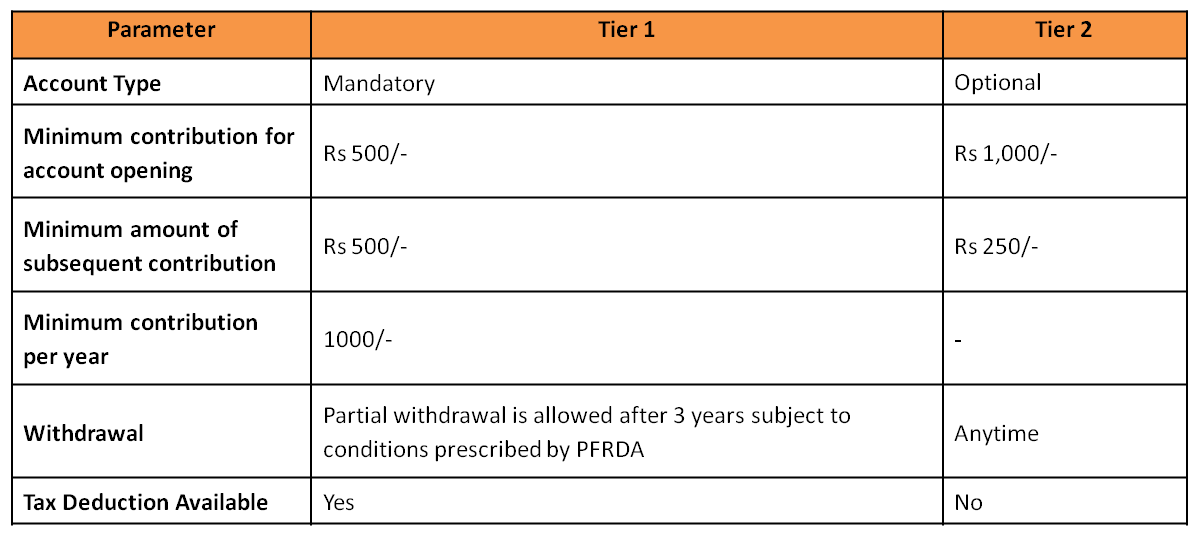
Remember, this deduction benefit is available only on Tier 1 NPS accounts. Tier 2 account is not eligible for any tax deduction. Read ahead to know more about features.
Options fitting your needs
There are two types of NPS accounts: Tier 1 and Tier 2. Both differ on several parameters like:
img
Offers Flexibility in choosing the desired asset allocation
  • NPS offers 2 choices for asset allocation between Equity and Debt: Active and Auto choice
img
Besides this, it provides flexibility to subscriber to change Pension Fund Manager once in a financial year and investment Option twice in a financial year.
Share:

Search This Blog

Powered by Blogger.

Should you invest in small cap mutual funds

1. A mutual fund's risk depends on its exposure to companies. 2. There's also no guarantee that a risky fund will generate high...

Recent Posts

Pages